
On 8 August a reader — Finn — emailed us a photograph of a till receipt from the McDonald’s at Lotissement du Blanc Pignon, RN 42, in Saint-Martin-Boulogne.
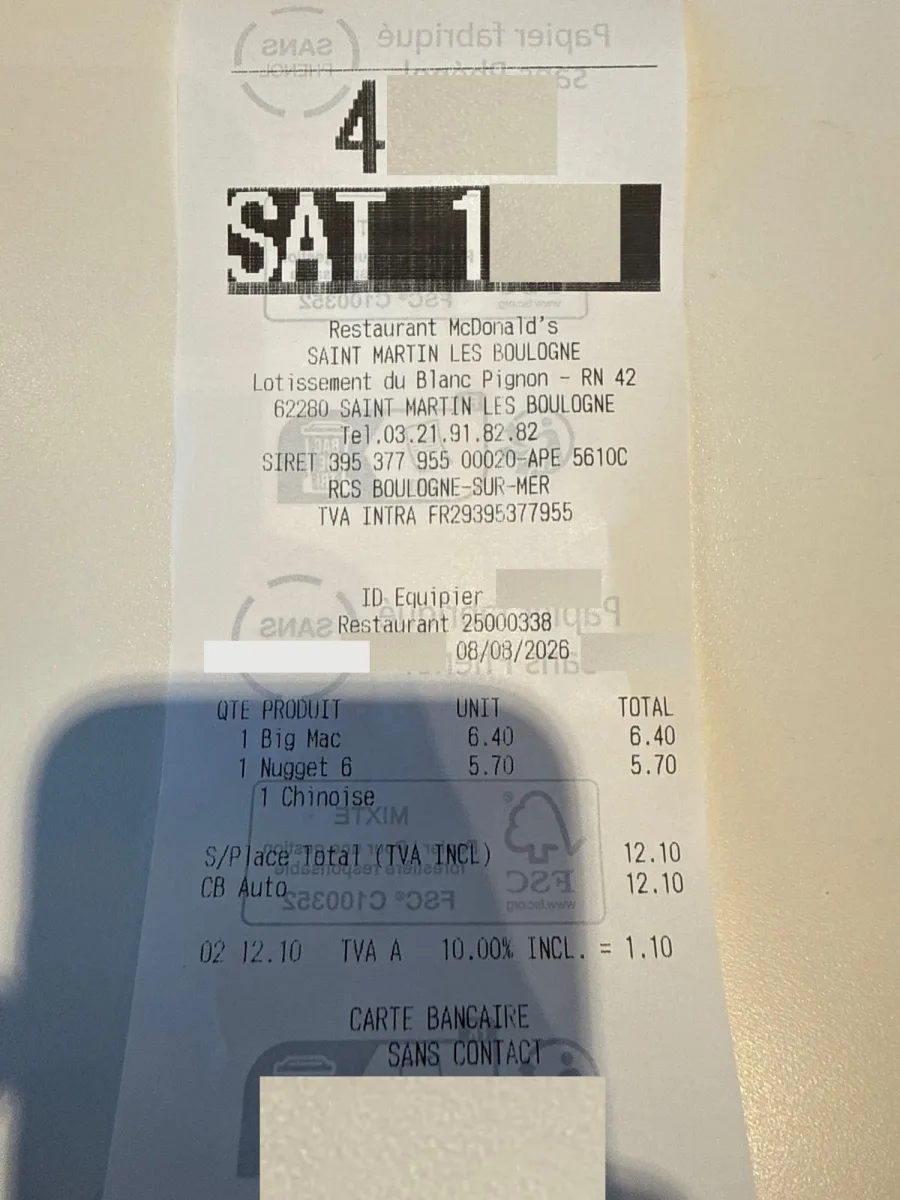
One line of it is the whole story: a standalone Big Mac, dine-in, €6.40.
We publish €6.35 for France. Finn’s receipt says €6.40. We were off by 0.79% — five cents.
Which is a boring result, and we are going to spend the rest of this piece explaining why it is the most useful email we have received since the one from Egypt.
The receipt is internally consistent, which matters
Before anything else: this receipt checks out on its own arithmetic. €6.40 + €5.70 = €12.10, which
matches the stated total. The VAT line reads 10% included, €1.10 — and €12.10 × (0.10 ÷ 1.10) =
€1.10 exactly. The 10% rate is the French restaurant rate for dine-in service, which is what
S/Place means.
That is worth pausing on, because it independently confirms a claim we have been making in the France deep-dive and the eurozone meta-analysis since May: France runs 10% VAT across the restaurant bundle, against Germany’s 7% food / 19% drink split and the Netherlands’ flat 9%. We asserted that from tax documentation. Now we have a French till printing it.
The €6.40 is also unambiguously the standalone burger, not a menu. There is a separate Nugget 6 line at €5.70 and no combo discount. This is the number the Big Mac Index actually wants, and most price submissions we get are not this clean.
Why we are not changing €6.35 to €6.40
We got the same question about Egypt, and the answer is different this time — so it is worth spelling out.
For Egypt, the argument was synchronisation: The Economist prices all 54 countries on the same day, and swapping one country to today’s menu breaks the comparison.
France is not in that CSV. The Economist does not publish France. It publishes “Euro area” — one row, €6.19, standing in for the entire currency union. Our €6.35 is our own desk research, so the synchronisation argument does not apply.
The reason is simpler and more boring: €6.35 is a national average and Finn’s receipt is one store.
France runs 1,500+ franchises that set their own prices inside central recommendations. Le Parisien’s 2023 national survey — still the only city-by-city audit anyone has published — found €4.45 in Vincennes and €6.90 in Dijon, a 55% spread inside one country, one currency, one VAT regime. Against a distribution that wide, moving the national mean because of a single observation five cents away from it would be mistaking variance for signal. The receipt lands inside the distribution we already published. That is the correct outcome, not a reason to move the mean.
So the national figure stays at €6.35. What changes is everything around it.
What actually changed
Confidence: 0.84 → 0.88. Not because the price got more precise — it did not move. Because the evidence tier did. Until 8 August, every link in our France chain was a secondary aggregator: france-inflation.com, fastfoodsmenu.com, fou-food.fr, a 2023 newspaper survey inflated forward. Reasonable sources, all of them one step removed from a cash register. Now there is a physical document at the bottom of the stack, and it agrees.
A new city entry. Saint-Martin-Boulogne joins Paris, Lyon and Marseille in our France city table at €6.40, confidence 0.95 — the highest city-level confidence in the entire dataset, and the only one anywhere in it backed by a receipt rather than an aggregator reading.
One class of source got demoted. French price aggregators in 2026 are still reporting “Big Mac seul: €5.20–€5.90.” A real August 2026 receipt from a provincial store says €6.40. Those aggregator figures sit 8% to 19% below ground truth, and they agree with each other because they are copying each other, not because they are independently right. Consensus among content farms is not corroboration. We have stopped treating that tier as a cross-check.
The part we did not expect
Here is where the receipt stops being a footnote about our error bars.
Saint-Martin-Boulogne is a commune of roughly 11,000 people, 13.2 km², in the Boulogne-sur-Mer agglomeration on the Channel coast. It is not Paris. It is not a tourist zone. It is not an airport or a gare. It sits in Pas-de-Calais — the department with the second-lowest median living standard in mainland France, where INSEE puts median living standard at roughly €22,000–24,000 and the poverty rate around 18%.
And it prices a Big Mac at €6.40.
| Figure | Local price | USD | vs US ($6.22) |
|---|---|---|---|
| Saint-Martin-Boulogne receipt | €6.40 | $7.32 | +17.7% |
| The Economist “Euro area” (Jul 2026) | €6.19 | $7.08 | +13.8% |
| Our France national figure | €6.35 | — | — |
| United States (Jul 2026) | $6.22 | $6.22 | — |
USD conversion uses The Economist’s own July 2026 euro rate (0.87439 EUR per USD), so the receipt and the aggregate are compared on the same rate, not on two different ones.
At $7.32, this one provincial French store would rank seventh in the world on the July 2026 index — above Sweden ($7.16), above Denmark ($7.04), above Turkey ($6.91), and 3.4% above the “Euro area” line that is supposed to represent it.
This is the aggregate problem, printed on a till
We argued in The Eurozone Big Mac Aggregate Is a Fiction that collapsing the euro area’s member states into one “EUZ” row destroys information. The version of that argument we could make in May was between-country: Spain €5.40 against France €6.35, a 17% spread inside one currency.
Finn’s receipt makes a sharper version of it. The implicit defence of a currency-union aggregate is that it averages out — expensive capitals against cheap provinces, and the mean lands somewhere representative. That defence requires the cheap provinces to actually be cheap.
Here is a commune of 11,000 in France’s second-poorest department, and it is above the euro-area mean. If the low end of the French distribution is already above the aggregate, the aggregate is not sitting in the middle of anything. It is sitting below a country that constitutes roughly a fifth of the currency union’s GDP, at basically every point in that country’s own distribution.
There is a second reading of the same number, and it is about time rather than geography. In Le Parisien’s 2023 survey, €6.90 in Dijon was the most expensive Big Mac in France — the national ceiling. Three years later, a store in a small Pas-de-Calais commune is at €6.40, within 7% of what used to be the national maximum. The floor has walked most of the way to where the ceiling was.
Two things we could not verify, and are saying so
We could not re-check the national tracker. france-inflation.com — our primary source for the €6.35 monthly average — returned HTTP 403 when we tried to refresh it for this piece. So €6.35 remains our May reading, now validated against one August receipt rather than re-derived. If it has drifted, we will catch it on the next full France review.
One receipt is one receipt. It is the strongest single piece of evidence in our France file and it is still n=1. The conclusions above about the euro-area aggregate would be much stronger with ten of them, from ten départements.
Which is a request, not a disclaimer. If you are in France — or anywhere in the eurozone — and you have a receipt, we would like it.
We published the receipt with parts blacked out, on purpose
A receipt is a document about a shop, and also a document about a person. The shop half — the address, the SIRET, the VAT number, the menu lines, the tax rate — is public commercial information, and it is the entire evidentiary point. The person half is not ours to hand out.
So the image above is redacted exactly where the two halves overlap:
- The payment block is gone entirely — card scheme, issuing bank, contactless flag, authorisation data. Which bank someone uses is nobody’s business, and none of it bears on the price of a burger.
- The exact transaction time and terminal number are blacked out. The date stays, because the date is the claim. It is the second-level timestamp plus terminal ID that turns a receipt into a lookup key against the store’s own transaction log.
- The staff ID is blacked out. Whoever worked that till is a third party who was never asked and gets nothing out of this.
What remains is the store, the date, the items, the prices and the VAT line — everything you need to check our arithmetic, and nothing you need to identify a customer.
Credit follows the same default we set out in July: first name only, unless the sender says otherwise. Finn has been asked how he would like to be credited, and whether he is comfortable with the redacted image being published at all. If he would rather it came down, it comes down.
How to send one
The format that makes a report immediately usable — Finn’s hit all four:
- The standalone Big Mac price (not a menu, not a combo, not a promo)
- Where — town and store, because a single price with no location cannot be interpreted
- When — the date you saw it
- A source — a till receipt or a photo of the menu board is ideal; the official McDelivery site for your country works too
Send to [email protected].
We are especially short on the eurozone’s smaller members — Portugal, Greece, Austria, Belgium, Ireland — where the published aggregator coverage thins out and the “EUZ” row is doing the most work covering for missing data.
Thank you, Finn. You confirmed a number we had guessed at, disproved a tier of sources we had been half-trusting, and handed us the cleanest single piece of evidence we own that the euro area is not one country.
France’s national figure remains €6.35, unchanged. Confidence raised from 0.84 to 0.88 on 10 August 2026. Saint-Martin-Boulogne added at €6.40 as a city-level data point, sourced to a reader receipt dated 8 August 2026, credited to “Finn”. See the France page for the full source list and the methodology page for how source tiers and confidence scores work.