Why There’s No McDonald’s in Turkmenistan (2026)
Of all the white spots on the Big Mac Index map, Turkmenistan is the one that confuses people most. It isn’t sanctioned the way Iran is. It isn’t blockaded the way Cuba is. It isn’t ideologically sealed the way North Korea is. It isn’t deliberately filtering global brands the way Bhutan is. It signed up to a UN-recognised status of Permanent Neutrality in 1995 and has spent the three decades since insisting, loudly and at every international podium, that it is open to the world.
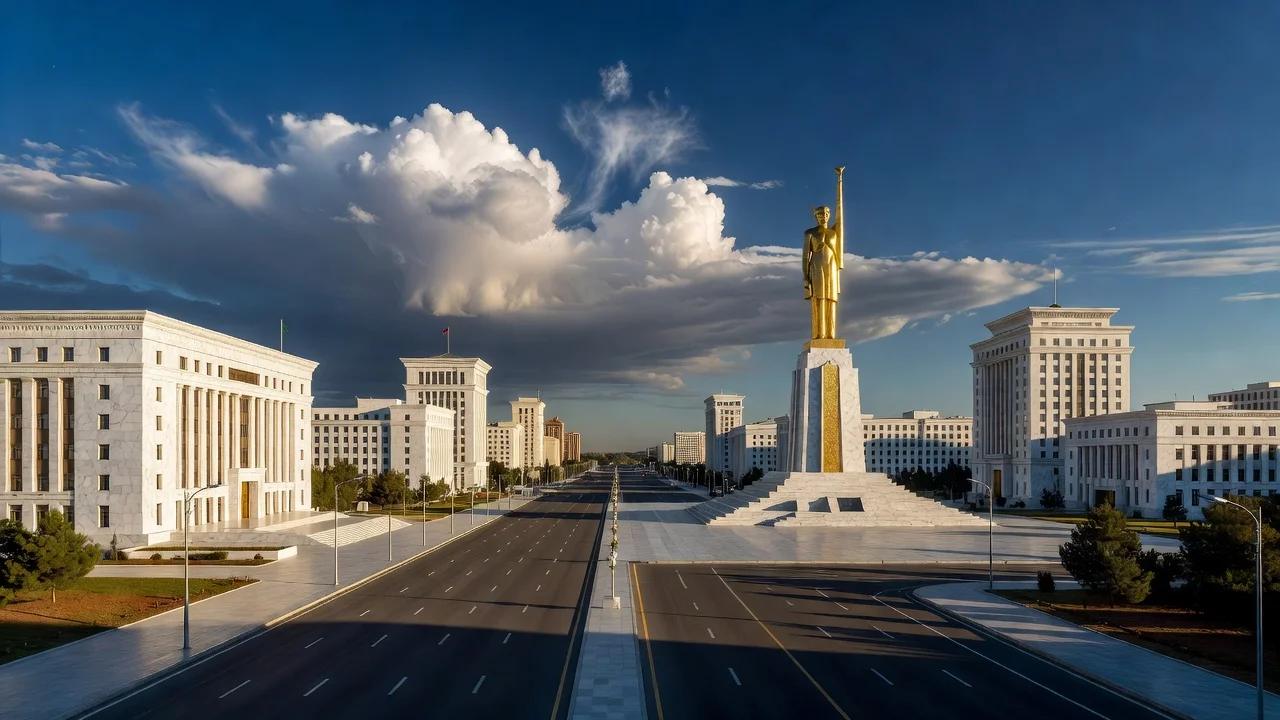
And yet Ashgabat — a city of white marble apartment blocks, fountains running through the desert, gold-leaf statues of dead presidents, and a Guinness record for the highest density of white marble buildings in the world — has no McDonald’s. No KFC. No Burger King. No Subway. No Starbucks. No Pizza Hut. Not in the Berkarar mall, not on Garaşsyzlyk Avenue, not in the Avaza tourist zone on the Caspian.
This is the ninth entry in the no-McDonald’s series after Russia, Iran, Iceland, Cuba, Bolivia, North Korea, Yemen and Bhutan. Turkmenistan is its own category: closed by political idiosyncrasy rather than by ideology, sanctions, embargo or design.
The short answer
McDonald’s has never operated a restaurant in Turkmenistan. Neither has any other Western quick-service chain. The absence is not the result of a single statute — Turkmenistan is not on the US sanctions list the way Iran or North Korea are — but of a stack of overlapping facts: a 1991–2006 founding cult of personality under Saparmurat Niyazov that excluded Western consumer culture from the public square; a post-2006 Berdimuhamedow dynasty that has continued, broadly, the same posture; a UN-recognised status of Permanent Neutrality that the state interprets as keeping geopolitical distance from the US-led order without picking a fight; a dual exchange-rate regime that makes repatriating dollar profits effectively impossible; and a foreign-investment environment that international corporate counsel reads as too risky to enter. The chain has not announced a Turkmenistan plan in any public filing, and the Saiga Tours field report on fast food in Central Asia says explicitly that there are “no plans to open any international chains in Turkmenistan and it seems quite unlikely for the foreseeable future” (Saiga Tours: Fast food in Central Asia).
The Niyazov era, 1991–2006
You can’t tell the Turkmen story without Saparmurat Niyazov. He was the last First Secretary of the Turkmen Communist Party when the Soviet Union dissolved in 1991, transitioned smoothly into being the first President of independent Turkmenistan, and within a few years had built one of the most extravagant personality cults of the post-Soviet world (Britannica: Saparmurad Niyazov; Facts and Details: Niyazov’s Personality Cult).
He took the title Türkmenbaşy — Leader of All the Turkmen — in 1993. His face was printed on every banknote, on every street-level billboard, and on a brand of vodka in a nominally Muslim country. His name was attached to a month of the calendar (January was renamed Türkmenbaşy), to a Caspian port city, to an airport, to schools and hospitals. In 1998 a 12-metre gold-leaf statue of him was erected on top of the 75-metre Arch of Neutrality in central Ashgabat, set to rotate so that the Father of the Turkmen would always face the sun (Atlas Obscura: Arch of Neutrality; RFE/RL: Golden Turkmenbashi Finds New Home).
Then came the Rukhnama — the “Book of the Soul” — published in two volumes (2001 and 2004). It was a sprawling, stream-of-consciousness work mixing Turkmen folk history, Niyazov’s own biography, advice on correct moral behaviour, and a programmatic vision for a Turkmen golden age. The text was placed alongside the Quran in mosques on Niyazov’s instruction, was required reading at every level of the education system, and formed roughly a third of the civil-service entrance exam (NPR: Niyazov’s Cult of Personality Grips Turkmenistan).
The retail consequence is not that Niyazov banned McDonald’s. He didn’t have to. The 1990s were the decade in which the chain was expanding aggressively into post-Soviet space — Moscow 1990, Warsaw 1992, Almaty later — and Turkmenistan was the one ex-Soviet republic in which entry was never discussed. The political risk for a Western corporation of opening under a regime that printed Niyazov’s face on the vodka was, charitably, hard to underwrite. And Niyazov’s economic policy — heavily subsidised gas, water and electricity for citizens (free, in effect, until 2017), state control of food retail, a fixed exchange rate that the central bank refused to defend at market prices — left no space for a franchise model designed around dollar-denominated royalties.
Berdimuhamedow, father and son, 2006 to now
Niyazov died unexpectedly in December 2006. Power passed, after a brief internal manoeuvre, to Gurbanguly Berdimuhamedow, a former dentist who had served as Minister of Health and Deputy Prime Minister under Niyazov. He won an essentially uncontested 2007 election with 89 percent of the vote and held the presidency until 2022.
The international coverage at the time framed Berdimuhamedow as a potential reformer. He briefly de-emphasised the Rukhnama in schools, restored the previous calendar (January went back to being January), and removed the rotating golden statue from the Arch of Neutrality — although he had it re-erected in 2011 on a new plinth on the outskirts of the city, still gold-leafed, still facing the sun (Eurasianet: Golden Statue of Late President Disappears). The personality cult shifted from father to successor rather than dissolving. By the 2010s Berdimuhamedow had his own equestrian gold statue, his own book series on Turkmen horses, dogs and tea, and a 24-hour state television presence singing his praises.
In February 2022 he engineered an early presidential election in favour of his son Serdar Berdimuhamedow, who won with 73 percent. Gurbanguly retired into the newly elevated role of “National Leader of the Turkmen People” and chair of the Halk Maslahaty — the equivalent of an upper house with constitutional power — meaning the father retained substantive influence while the son took the title (Wikipedia: Serdar Berdimuhamedow; Carnegie Endowment: Like Father, Like Son).
The Bertelsmann BTI 2026 country report and the Carnegie analysis converge on the same conclusion: the anticipated reforms in market economy development, anti-corruption and human rights have not materialised under Serdar. Suppression of independent media has, if anything, intensified (BTI 2026 Turkmenistan). The dual exchange-rate regime remains in place. The state still owns the food retail chain. Whatever cautious modernisation is happening is digital and financial back-office stuff — payment systems, mobile money pilots — not consumer-brand opening.
Permanent Neutrality, 1995 — and what it actually means
Turkmenistan’s signature foreign-policy doctrine is Permanent Neutrality. On 12 December 1995, the UN General Assembly adopted resolution A/RES/50/80, recognising Turkmenistan’s declared status of permanent neutrality “without a vote” — that is, by consensus of 185 member states. Turkmenistan is, to this day, the only state with this specific UN-recognised status (UN Digital Library: A/RES/50/80; Diplomat Magazine: Permanent Neutrality of Turkmenistan).
It’s worth being clear that Turkmen Neutrality is not Swiss Neutrality. Switzerland’s posture is military and is paired with one of Europe’s most globalised economies — Nestlé, Swatch, UBS, a thick web of Western chain retail in every Swiss city. Turkmen Neutrality is a foreign-policy doctrine that the state uses to keep distance from every great power bloc: no Russian military bases (Turkmenistan is not a CSTO member), no formal Chinese alliance despite gas dependence, no NATO partnership beyond minimal Partnership-for-Peace contact, no membership of the Eurasian Economic Union, no formal accession to the WTO. The result is that the state can host pipeline diplomacy with China while declining to align politically, and can sell gas to anyone while keeping consumer-brand entry tightly controlled.
The 25-year retrospective from RFE/RL in 2020 argued that Turkmenistan had reaped close to zero economic benefit from this neutrality posture — no preferential trade access, no FDI surge, no diplomatic leverage proportional to the gas reserves the country sits on (RFE/RL: 25 Years Later, Turkmenistan Reaps Zero Benefits From ‘Positive Neutrality’). For a Western brand, neutrality reads less as openness than as a signal that the country prefers to be ignored by global capital.
Why the brand has not entered — and it’s not sanctions
Here is the part that surprises people. Turkmenistan is not subject to comprehensive US sanctions. It is not on the OFAC State Sponsors of Terrorism list. It has had diplomatic relations with the US since 1992. American companies operate in the country in selected verticals — Boeing has sold aircraft, Chevron has explored energy partnerships, US agriculture has cooperated on cotton. There is no legal bar to a McDonald’s franchise.
The reasons it has not opened are corporate-risk reasons, not legal ones:
- Foreign-exchange repatriation. Turkmenistan has run a dual exchange-rate regime since 2016. The official rate is fixed at 3.5 TMT/USD, unchanged since January 2015. The street rate in mid-2020s reporting has been quoted at 19 to 20+ TMT/USD, a black-market premium of around 450–550 percent (Wikipedia: Turkmen manat; progres.online policy brief, December 2022; Young Pioneer Tours: Changing money in Turkmenistan). A franchise that earns revenue in manat and has to pay royalties in dollars cannot route through the official rate (the central bank rations dollar conversions to favoured importers) or the street rate (which is technically illegal). This problem is structurally similar to Iran’s rial regime, and it kills the unit economics of any branded retail business that the state isn’t actively sponsoring.
- Property and licence ownership. Foreign-investment law restricts who can own land and operating premises. The standard franchise model — local master franchisee, brand licence agreement, royalty stream — requires a legal counterparty with reliable enforcement, and Turkmenistan does not have an independent court system the US franchisor would trust.
- Political optics. Operating in a country whose human-rights record sits near the bottom of every annual index — Freedom House scores Turkmenistan among the least-free countries globally — exposes a brand like McDonald’s to reputational risk. The 2018 Saudi Arabia and 2022 Russia precedents have made global QSR brands considerably more cautious about openings in autocratic environments.
- Market size. Turkmenistan has roughly 7 million people, the smallest population in Central Asia, concentrated overwhelmingly in Ashgabat. The disposable-income base outside the capital is thin. Even Kazakhstan — much larger, much richer, with a freer FX regime — only got its first McDonald’s in 2016, and that store later closed in 2022 after the parent’s withdrawal from Russia disrupted Eurasian supply chains.
None of these are insurmountable individually. Stacked, they have produced 34 years of no-entry.
What people in Ashgabat actually eat instead
Turkmen cuisine is not McDonald’s-shaped. The everyday staples are plov (rice with mutton, carrot, onion), manty (steamed dumplings), çorba (lamb soup), gutap (stuffed flatbread), somsa (baked stuffed pastry), and grilled şaşlyk on skewers. Bread is çörek, baked daily in tandoor ovens. None of these dispense from a window in 60 seconds. The fast-format eating that does happen runs on döner kebabs, somsa stands, samsa carts, and small canteens.
The closest thing to a Western-style food court is the Berkarar shopping and entertainment centre, which opened in December 2014 in central Ashgabat. Its food court hosts local brands — Burger Zone, Kudo Kudo Fried Chicken, MB Doner Kebab — alongside Turkish and Uzbek restaurants. These are independent or family-chain operations, not McDonald’s analogues. They do not have a standardised menu across multiple branches, do not run on franchise royalty streams, and do not anchor a global QSR-style supply chain (Tripadvisor: Berkarar reviews; Tripadvisor: Burger Zone, Ashgabat).
There is also an unofficial X/Twitter account branded “KFC Ashgabat” that occasionally circulates among Central Asia watchers. KFC’s official store locator does not list Turkmenistan, and KFC’s parent Yum Brands has not announced market entry. The account is not a franchise; it appears to be either parody or a small unbranded operator using the imagery — neither of which would survive a Yum legal review if the country mattered enough to them (Wikipedia: List of countries with KFC franchises).
The dual exchange rate, in detail
For Big Mac Index purposes, the manat is the most important variable in this story and the one that would prevent meaningful PPP measurement even if a Big Mac existed.
The official central-bank rate has been 3.5 TMT/USD since January 2015, when the manat was sharply devalued from a previous peg of 2.85 TMT/USD. It has not moved since. The central bank does not openly defend this rate — it rations dollar conversions through quotas, prioritising state-owned importers of food, fuel and medicine over private buyers (XTransfer wiki: Turkmenistani manat).
The unofficial street rate has been quoted in the 19–20 TMT/USD range in mid-2020s reporting from independent outlets covering Turkmenistan from abroad. The progres.online policy brief in December 2022 calculated a black-market premium of around 557 percent at that time. Travellers’ forums on Caravanistan have logged street-rate trades in roughly the same band over multiple years (Caravanistan forum: Turkmen manat black market exchange rates).
This means any imported good — and a Big Mac is, in the Turkmen context, an entirely imported good in everything but bun and salad — has two prices: a notional official-rate price the state will quote and a real-economy price that reflects how dollars actually trade. A hypothetical 30 TMT Big Mac would be either $8.57 (official) or $1.50 (street), and neither number would be honestly comparable to Switzerland’s CHF 7 or Mexico’s MXN 85. The Iran writeup walks through the same problem with rials (Iran writeup →) and reaches the same conclusion: dual-rate countries break the index by construction.
Compared to North Korea, Cuba and Bhutan
It’s worth seeing where Turkmenistan sits in the broader “no McDonald’s” cluster:
- vs North Korea. Both are closed economies with no Big Mac and no franchise plan. The DPRK is closed by Juche ideology and US sanctions; Turkmenistan is closed by personality cult and an opaque foreign-investment environment, but is not under comprehensive US sanctions. North Korea’s exclusion is a wall; Turkmenistan’s is a maze. (NK writeup →)
- vs Cuba. Cuba is excluded by US embargo from the supply side. Turkmenistan has no such embargo — American firms can legally operate there. The mechanism is regulatory friction and FX, not legal prohibition. (Cuba writeup →)
- vs Iran. Both have a dual exchange rate that makes PPP measurement break. Iran has shadow proxy chains (Mash Donald’s) that allow a rough shadow price. Turkmenistan has no proxy and no chain at the right product profile. (Iran writeup →)
- vs Bhutan. Bhutan’s exclusion is a chosen cultural-protection policy under Gross National Happiness, run by an elected democratic government that the population keeps re-electing on this platform. Turkmenistan’s exclusion is not chosen by the population in any voting-based sense — it is the by-product of a non-democratic dynasty’s preference for control. (Bhutan writeup →)
The cleanest framing: NK is “would never let them in,” Cuba is “America wouldn’t let them in,” Iran is “had them, lost them, can’t get them back,” Bhutan is “thought about it and politely declined,” Turkmenistan is “nobody on either side wants this enough to overcome the friction.”
What this means for the Big Mac Index
For bigmacindex.app, Turkmenistan sits in the same permanent-grey bucket as North Korea. The reasons are different but the data status is identical:
- No direct Big Mac price. No McDonald’s exists.
- No franchise successor. Local burger stands at Berkarar are not standardised enough to act as proxies.
- No usable exchange rate. The official 3.5 TMT/USD is fictional; the 19+ TMT/USD street rate is technically illegal and inconsistently reported.
- No reliable price data. Turkmenistan does not publish meaningful CPI breakdowns at the item level, and the IMF’s most recent Article IV consultation noted ongoing concerns about data reliability (IMF: Turkmenistan country page).
This is why Turkmenistan belongs in the PPP failure cases bucket. The precondition for a Big Mac comparison — a comparable retail product priced in a market-clearing currency — fails on both legs. I’ll keep the country listed on the main index as a greyed entry with a link to this writeup, which is what I’d want a reader to find if they came searching.
For methodology background, see the 2026 Big Mac Index breakdown and the methodology page.
FAQ
Will the post-2017 Avaza tourism push change this? Probably not in the next five years. Avaza is a Caspian coastal resort area that has been slowly opened to limited foreign tourism since around 2017, with discussions of a simplified visa regime for the zone resurfacing in 2023. The visitor volumes are too small, and the visa regime around the rest of the country too restrictive, to make Avaza a foothold for a global QSR brand. Western fast food entry typically requires a metropolitan anchor and supply-chain backbone, not a coastal resort with seasonal traffic.
Are KFC, Burger King or Subway in Ashgabat? No. None of the major Western quick-service chains operate in Turkmenistan. KFC has stores in Kazakhstan (since 2016), Kyrgyzstan, Uzbekistan and Tajikistan but not in Turkmenistan. Burger King has not announced a market entry. The unofficial “KFC Ashgabat” social media account is not an authorised franchise.
Will the Berdimuhamedow family open the country to Western brands? Nothing in the Serdar Berdimuhamedow record from 2022 onward suggests this is a priority. BTI 2026 and Carnegie Endowment analyses both characterise the current period as a tightening of state control rather than a reform window. A succession event — for example, a future leadership transition outside the family — could in principle change the calculation, but that is not visible on any current timeline.
Does the manat black market reflect the real price level? Approximately, but with caveats. The 19–20 TMT/USD street rate is closer to the underlying economic reality than the 3.5 TMT/USD official rate, in the sense that it reflects what dollars actually fetch when traded freely. But the street market is shallow, varies by city, gets squeezed during state crackdowns, and is not reported by any official channel. A Big Mac priced at the street rate would be a more honest number than one priced at the official rate, but neither would be statistically robust.
How is this different from North Korea? North Korea excludes Western brands by ideology and by sanctions. Turkmenistan excludes them by friction. The DPRK has chosen to be hostile; Turkmenistan has chosen to be incommensurable — to use neutrality and opacity as a way of not engaging on the terms global capital expects. The retail effect is the same; the underlying logic is different.
Sources used in this article
- UN Digital Library: A/RES/50/80 — Permanent Neutrality of Turkmenistan (1995)
- Diplomat Magazine: The Permanent Neutrality of Turkmenistan
- RFE/RL: 25 Years Later, Turkmenistan Reaps Zero Benefits From ‘Positive Neutrality’
- Britannica: Saparmurad Niyazov
- NPR: Niyazov’s Cult of Personality Grips Turkmenistan
- Facts and Details: Niyazov’s Personality Cult
- RFE/RL: Golden Turkmenbashi Finds New Home
- Eurasianet: Golden Statue of Late President Disappears
- Wikipedia: Serdar Berdimuhamedow
- Carnegie Endowment: Like Father, Like Son — Why Turkmenistan’s Power Transition Is In Reverse
- BTI 2026 Turkmenistan Country Report
- Wikipedia: Turkmen manat
- progres.online: Effects of Turkmenistan’s dual exchange rates (December 2022)
- Saiga Tours: Fast food in Central Asia
- Tripadvisor: Berkarar Shopping Centre, Ashgabat
Want to see where McDonald’s is? Big Mac Index data → · Methodology → · Spot a mistake? Email me at [email protected].