Why There’s No McDonald’s in North Macedonia (2026)
I added North Macedonia to the “missing countries” list after a verify pass on Bulgaria came back the wrong way. Bulgaria, it turns out, still has roughly 47 McDonald’s across Sofia, Plovdiv, and Varna — not a post-exit case at all. North Macedonia is the genuine Balkans post-exit story, and a stranger one than I expected when I started reading.
The country had McDonald’s for sixteen years. Then on a Tuesday afternoon in May 2013, all seven restaurants — six in Skopje, one in Ohrid — locked their doors with handwritten “temporarily closed” notices taped to the glass. They never opened again. Thirteen years on, the most prominent former location, on Skopje’s main square, has been swallowed by the city’s neoclassical rebuild project. Burger King eventually moved into the gap, but slowly, and never in the same buildings.
This isn’t a sanctions story, an economic-collapse story, or a culture-of-resistance story. It’s a story about a franchise contract.
The short answer
McDonald’s operated in Macedonia (now North Macedonia) from September 6, 1997 until May 14, 2013. The local franchisee was SJ Company, owned by Svetozar “Sveto” Janevski, a Skopje businessman whose original twenty-year development license dated to the mid-1990s. McDonald’s Europe terminated that license unilaterally on May 14, 2013, citing unspecified contractual issues. All seven restaurants closed within 48 hours. The chain has not reopened in the country since. No successor brand inherited the locations — they were repurposed individually, some absorbed by the Skopje 2014 urban redevelopment, others sold off to local tenants. Burger King entered Skopje in 2018, KFC followed, but neither claims McDonald’s’s former footprint. A Burger King Whopper Menu in Skopje runs around 450 MKD (~$8.30 USD) in mid-2026, with the denar trading near 54 MKD/USD (Wise: MKD-USD).
1997: McDonald’s arrives in Skopje
The first Macedonian McDonald’s opened on September 6, 1997, on the central square in Skopje, a few hundred metres from the Stone Bridge over the Vardar river (Skopje City Guide: McDonald’s in Macedonia). This was six years after Macedonia declared independence from Yugoslavia, in a country still negotiating its name dispute with Greece, still finding its footing as a market economy.
Svetozar Janevski’s SJ Company won the development license. Janevski was already a prominent Skopje businessman — later he would expand into brewing (Skopsko), media, and real estate. The McDonald’s deal was framed as a long-term commitment: a twenty-year development agreement, renewable in five-year increments (Telegrafi: Eventually no more McDonald’s in Macedonia).
The first store was, by Skopje standards of the late 1990s, an event. It drew crowds for weeks. McDonald’s became a kind of shorthand for the country’s western turn — a marker that Macedonia, unlike its neighbours in the brutal 1990s Balkans, had skipped most of the wars and was open for business.
1997 to 2013: the slow build
Expansion was gradual rather than aggressive. Over sixteen years, SJ Company grew the network to seven restaurants:
- Six in Skopje, including locations on the central square, near the City Mall, and at Skopje International Airport
- One in Ohrid, the tourist town on Lake Ohrid that draws most of the country’s summer visitors
That’s roughly one restaurant every two-and-a-half years, in a country of about two million people. By comparison, neighbouring Serbia at the same population-adjusted ratio would have closer to thirty stores. Macedonia’s McDonald’s footprint was modest, urban, and tourist-adjacent — not the dense suburban-drive-through model the chain runs in higher-income markets.
There’s no public evidence the Macedonian McDonald’s were losing money. Janevski’s network reportedly served meals at prices competitive with the broader Balkan region, and the brand was popular with families, students, and visitors. This is one reason the closure caught so many people by surprise.
May 14, 2013: the day it all went dark
On the afternoon of Tuesday, May 14, 2013, McDonald’s Europe terminated SJ Company’s development license. Within roughly 48 hours, every one of the seven Macedonian restaurants closed. Customers arriving on May 15 and 16 found brief printed notes on the doors stating the premises were “temporarily closed” (Balkan Insight, May 17, 2013).
Agnes Vadnai, then communications head for McDonald’s Europe, confirmed the shutdown but gave no explanation:
“After the termination of the agreement, [Macedonia’s] SJ Company no longer has the right to work with the McDonald’s franchise.”
That was effectively the entire corporate statement. No reason for the termination, no indication of whether McDonald’s intended to relicense the territory, no transition plan. Macedonian state inspectors publicly clarified the closure was not triggered by any government action — no health-code raid, no tax issue, no regulatory dispute (Balkan Insight, May 17, 2013).
Janevski himself, speaking to local press a few days later, framed it as a corporate decision he had no control over. He said SJ Company had lost the license because McDonald’s’s European office chose to terminate the long-running contract. He did not elaborate on the underlying disagreement (SeeNews: McDonald’s Europe ends franchise deal with Macedonia licensee).
The dispute: best available reading
Public reporting from 2013 onwards suggests the termination was rooted in contract performance and financial obligations — not politics, not a McDonald’s strategic exit. Several Macedonian and regional outlets reported, without naming sources, that the dispute centred on the franchisee’s ability to meet certain payment, royalty, or expansion targets under the development agreement (Skopje City Guide; Telegrafi).
It’s worth being careful here. McDonald’s never published the specifics. SJ Company never published the specifics. What’s documented is the outcome: a twenty-year development license, terminated mid-stream, with both sides going silent.
This pattern — corporation terminates a long-running developmental licensee, refuses to publicly explain, and chooses not to immediately relicense the territory — is unusual but not unique in McDonald’s’s global history. The closer analogues are smaller emerging markets where the chain has decided the franchise relationship was a bigger headache than the revenue justified. Sri Lanka 2024 is the most recent comparison; Bolivia 2002 the most studied (Bolivia writeup →).
The Skopje 2014 backdrop
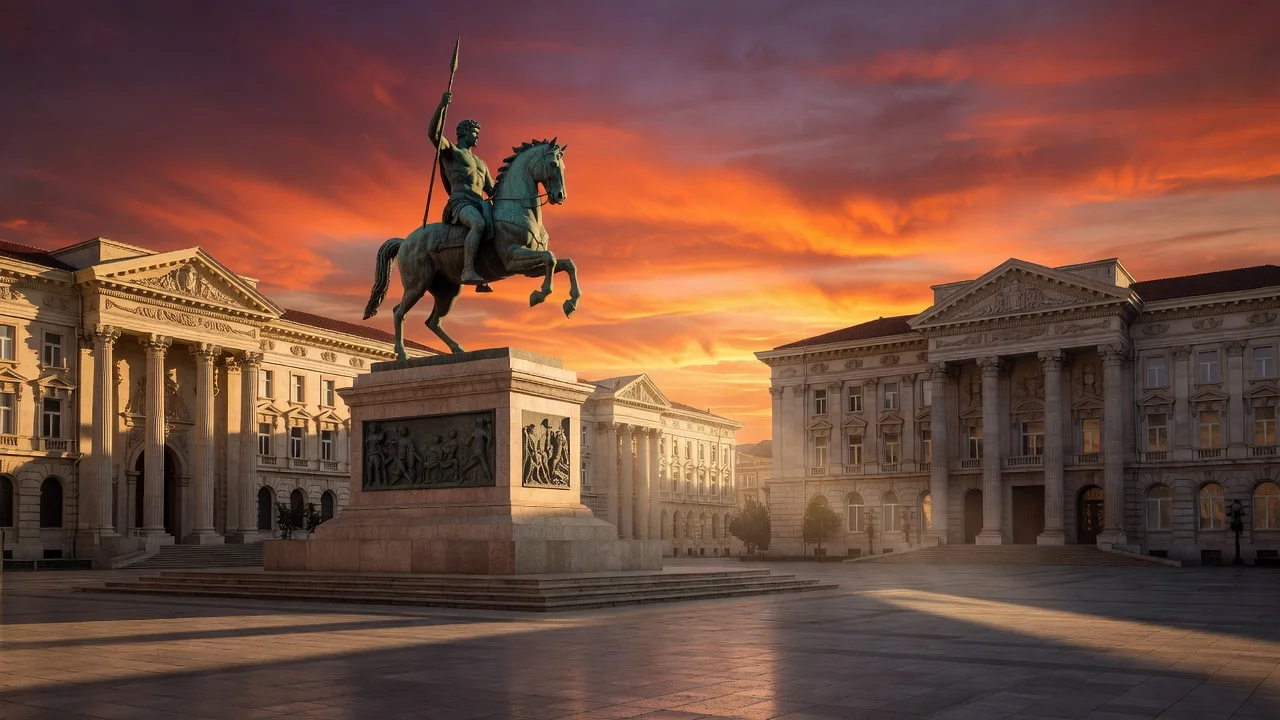
The closure landed in the middle of one of the strangest urban-redevelopment projects in modern Europe. Skopje 2014, launched by the VMRO-DPMNE government in 2010, set out to retrofit central Skopje with a neoclassical-baroque facade — over forty new monuments, statues, fountains, and government buildings, in styles borrowed from imperial Vienna, Rome, and Athens. The square outside the original McDonald’s was rebuilt around the giant Warrior on a Horse monument (widely understood to depict Alexander the Great, though never officially named that way during the Greek-name dispute).
By the time McDonald’s closed in May 2013, Skopje’s central square already looked nothing like the city the chain had entered in 1997. Several former fast-food sites along the redevelopment corridor were either demolished, reclad, or had their ground-floor retail repurposed for souvenir shops and cafes catering to the new tourist flow (Skopje City Guide).
This is context, not cause. The Skopje 2014 program didn’t push McDonald’s out. But it means the city the chain might have returned to is, visually and culturally, not the same Skopje where it built its first store.
No successor brand
This is the single thing that most clearly separates Macedonia from the other recent post-exit cases.
- In Russia, the 850 closed McDonald’s were rebranded almost immediately as Vkusno i tochka (“Tasty and That’s It”), under a Siberian oil money buyer (Russia writeup →).
- In Belarus, the chain rebranded to Mak.by, keeping similar menu items and most staff (Belarus writeup →).
- In Iceland, the three closed stores reopened as Metro within weeks under the same franchisee (Iceland writeup →).
- In Bolivia, the eight closed stores were sold off individually.
In Macedonia, the seven stores were also dispersed individually. No new brand inherited the staff, the recipes, the supply chain, or the brand recognition. The buildings became unrelated businesses — coffee shops, mobile-phone retailers, a betting shop. SJ Company moved on to other ventures and never attempted to launch a copycat burger chain.
The closest thing Macedonia has to a domestic-burger inheritor is Fast Food 7, a small local chain that predated McDonald’s’s exit and grew modestly afterward. But it’s not a McDonald’s successor in any meaningful sense.
2018: Burger King arrives
Burger King entered Skopje in 2018, more than five years after McDonald’s left. The first location opened near Macedonia Square, then expanded to Skopje International Airport, Skopje City Mall, Capitol Mall, and Ramstore. As of 2026 Burger King runs roughly five to six locations in the country, all in Skopje — none in Ohrid, none in Tetovo, none in Bitola (Wolt: Burger King Skopje).
KFC followed, opening its first Skopje store later in the 2010s. Today KFC runs about three Skopje locations including a drive-through (Skopje City Guide).
Neither chain claims continuity with the closed McDonald’s stores. They built fresh — new buildings, new staff, new supply chains. Skopje’s western-fast-food market in 2026 is a quieter, smaller version of what it was in 2010.
Outside the western brands, Skopje runs on kebapchinici (kebab houses serving the regional grilled-mincemeat dish), burek bakeries, and a handful of independent burger spots — none of which scale into national chains.
How this compares to the other post-exit cases
| Country | Exit year | Cause | Successor brand |
|---|---|---|---|
| Russia | 2022 | War / sanctions / corporate withdrawal | Vkusno i tochka |
| Belarus | 2024 | Sanctions follow-on | Mak.by |
| Iceland | 2009 | Currency collapse + import cost | Metro |
| Bolivia | 2002 | Commercial failure | None |
| North Macedonia | 2013 | Franchise license terminated | None |
| Bulgaria | — | Still operating (~47 stores) | n/a |
North Macedonia and Bolivia are the two cleanest “no political reason, no successor brand” cases. Bolivia’s exit was a commercial failure — the franchise lost money for five years. Macedonia’s exit was a contractual failure — the franchise was performing but couldn’t keep the license terms. Neither was driven by sanctions, war, or boycott.
This matters for any kind of cross-country comparison: McDonald’s leaves countries for an unexpectedly wide range of reasons, and “post-exit” isn’t a single category.
Shadow product: Burger King Whopper Menu, Skopje
For purposes of the Big Mac Index, a country without McDonald’s needs a comparable shadow product to estimate purchasing power. The cleanest option for Skopje in 2026 is the Burger King Whopper Menu (Whopper + medium fries + medium drink).
Documented pricing data points:
- 2021 (JoyDellaVita, Skopje Airport BK): Whopper Menu 380 MKD (JoyDellaVita, Feb 2021)
- 2026 estimate: roughly 450 MKD (~$8.30 USD) at 54 MKD/USD, allowing for cumulative inflation of ~18% across five years
I want to flag that the 2026 number is an extrapolation, not a fresh receipt. Burger King Macedonia doesn’t publish a public price list, the Wolt menus shift, and there is no Macedonian equivalent of the Economist’s data scrape. If anyone reading has a 2026 Skopje BK receipt, please send it.
For comparison, a Big Mac in neighbouring Bulgaria runs about 9.00 BGN (~$5.10 USD) as of mid-2026, and a Whopper in Sofia about 11 BGN (~$6.20 USD). Skopje’s Burger King price is meaningfully above Sofia’s — partly Burger King’s smaller scale in Macedonia, partly imported-input cost on the smaller market.
What this means for the Big Mac Index
North Macedonia is permanently absent from the Economist’s published Big Mac Index — no McDonald’s, no price, no row.
For my purposes on bigmacindex.app, I treat the country as a post-exit shadow case: shown on the map with a flag, an exit year, and the BK Whopper Menu as the proxy price. The confidence is lower than for a real McDonald’s-priced country, but the country is large enough and the data is consistent enough across years that it’s worth including with caveats. See PPP and the limits of the Big Mac Index for the broader framing.
The single biggest data gap I’d want filled: a current 2026 Burger King Skopje receipt with the Whopper Menu line item visible.
FAQ
Why did McDonald’s Corporation unilaterally terminate the Macedonian franchise? Officially, no public reason was ever given. Reporting at the time pointed to a contractual disagreement between McDonald’s Europe and SJ Company under their 20-year development agreement — most likely centred on payment, royalty, or expansion terms — but neither side disclosed specifics (Balkan Insight; SeeNews).
Did Sveto Janevski or SJ Company sue McDonald’s afterwards? I couldn’t find documentation of a publicly tracked Netherlands court case or international arbitration ruling from the SJ Company side. If post-2013 litigation exists, it’s not surfacing in English-language legal databases. Macedonian-language reporting is sparser than for higher-profile franchise disputes (e.g. the Russia exits). Treat any specific lawsuit claim as unverified until primary documents emerge.
Did the 2018-2019 name change from “Macedonia” to “North Macedonia” affect any of this? No. The Prespa Agreement, signed June 2018, resolved the long-running Greek name dispute and renamed the country the Republic of North Macedonia. That happened five years after the McDonald’s exit and had no bearing on the franchise situation. NATO membership followed in March 2020; EU candidate status remains pending.
Are any of the original McDonald’s buildings still recognizable in 2026 Skopje? A few are. The site of the original 1997 central-square store is now part of the Skopje 2014 redevelopment corridor; the building was reclad and converted to other retail use. The Skopje City Mall food court still has the rough footprint of the former McDonald’s, now occupied by other vendors. The Ohrid location, on the lake-front tourist strip, is now a coffee shop. No commemorative signage marks any of them.
Will McDonald’s ever return to North Macedonia? There’s no public indication either way. McDonald’s hasn’t announced plans to relicense the territory in any of the thirteen years since the exit. North Macedonia is a small market (population ~1.8 million, GDP per capita ~$8,000) sandwiched between Bulgaria (which the chain serves) and Greece (which it serves heavily). A return would require finding a new master franchisee willing to take on the build-out costs from scratch. The longer the gap, the less likely it gets.
Sources used in this article
- Balkan Insight: McDonald’s Restaurants Shut Down in Macedonia (May 17, 2013)
- SeeNews: McDonald’s Europe ends franchise deal with licence holder in Macedonia
- Skopje City Guide: Here’s Why You Won’t Find McDonald’s in Skopje
- Telegrafi: Eventually, there will be no more McDonald’s in Macedonia
- JoyDellaVita: Burger King Skopje North Macedonia Menu & Prices (Feb 2021)
- Wolt: Burger King Centar Skopje
- Wise: MKD to USD exchange rate
Want to see where McDonald’s is? Big Mac Index data → · 2026 complete breakdown → · Methodology → · Spot a mistake or have a Skopje receipt? Email me at [email protected].