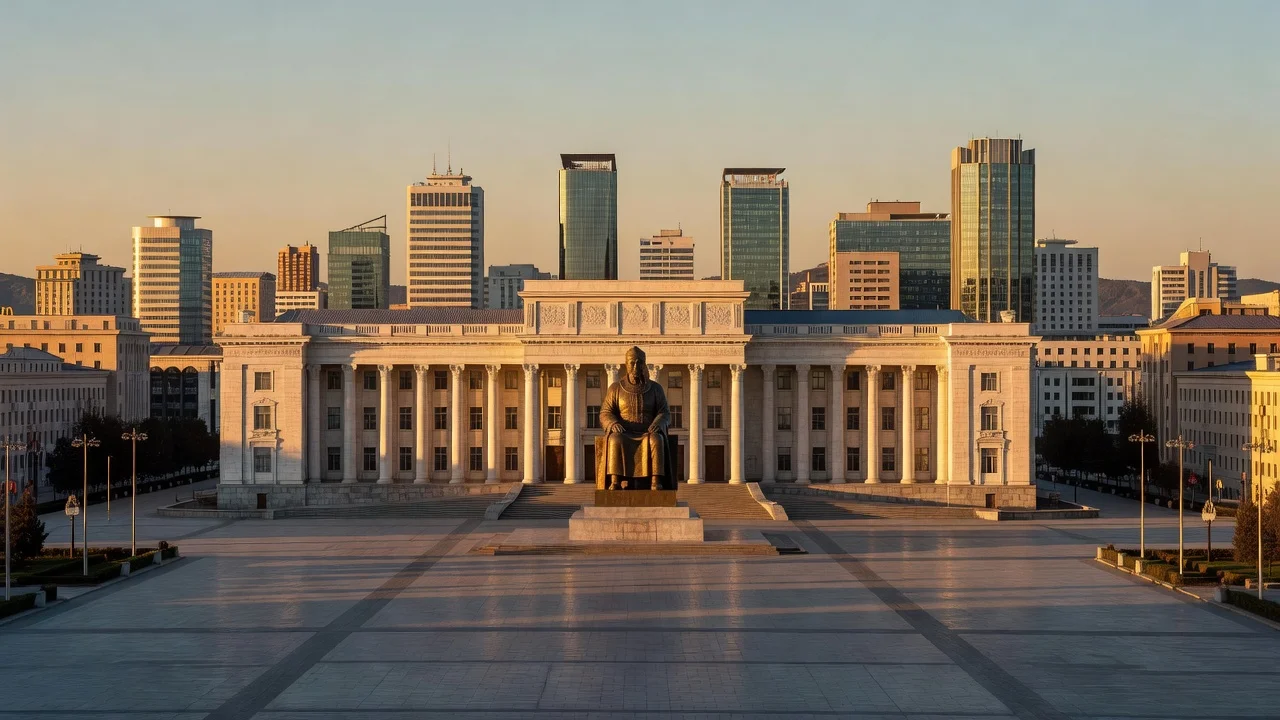
Why There’s No McDonald’s in Mongolia (2026)
Walk a single block off Sukhbaatar Square in central Ulaanbaatar in 2026 and you can buy a KFC Zinger combo, a Burger King Whopper, a squid-ink-bun burger from Black Burger Factory, or a khuushuur (fried mutton pastry) from a guanz the size of a closet. What you can’t buy, anywhere in the country, is a Big Mac.
Mongolia is one of the most interesting blank spots on the McDonald’s world map because the usual explanations don’t apply. It isn’t sanctioned. It isn’t at war. It isn’t culturally closed — KFC and Burger King both operate here. It’s a market-economy democracy of around 3.5 million people, half of them concentrated in one city. And McDonald’s, despite at least one well-documented near-miss, has simply never opened a location.
This is the fourth distinct category in my missing-countries set: not political (Cuba), not FX-collapse (Iceland), not grassroots rejection (Bolivia) — Mongolia is the “market organically said no thank you” case.
The short answer
McDonald’s has never opened a restaurant in Mongolia. There has been no franchise agreement, no public expansion announcement that came true, and no operating McDonald’s at any point in the country’s modern history. The closest the brand came to Mongolia was a December 2014 hoax, when a Mongolian TV station fed a fake McDonald’s press release to local outlets to test how easily Mongolian journalism would publish paid content as news. The story went global before it was exposed. McDonald’s corporate had nothing to do with it.
The actual reasons Mongolia has no McDonald’s, in rough order of importance:
- KFC got there first (May 2013) and absorbed the “first Western fast food” slot.
- Burger King followed in 2015 via Max Center LLC and now runs 12 locations.
- Ulaanbaatar already has a saturated local burger scene built up while Mongolia was being overlooked.
- The total addressable market is small — about 3.5M people, GDP per capita around $7,000 — and most of it is in one city, which caps McDonald’s standard rollout math.
- Beef supply chain doesn’t meet McDonald’s global standards despite Mongolia having more cattle than people.
Each of those needs more colour.
Pre-1990: Soviet satellite, no Western chains
From 1924 until the 1990 democratic revolution, Mongolia was the Mongolian People’s Republic, a one-party state aligned with the Soviet Union. Western consumer brands were structurally absent — not banned per se, just not permitted to operate in a centrally planned economy with no convertible currency and no franchise framework. The food economy was state canteens, state-run department stores, and household production from livestock.
McDonald’s, which was expanding aggressively in capitalist Asia through the 1980s (Japan 1971, Hong Kong 1975, Taiwan 1984, South Korea 1988), never had a path in. By the time the Iron Curtain fell, the brand was focused on the much larger Eastern European and former-Soviet markets — Russia (Moscow Pushkin Square, January 1990) absorbed enormous corporate attention.
Mongolia was, in the McDonald’s expansion view of the 1990s, a tiny landlocked market between two countries (Russia and China) that already had their own complicated McDonald’s stories. It got skipped.
1990-2010: democratic transition, Western brand wave bypasses Mongolia
The 1990s and 2000s were the global wave when McDonald’s opened in dozens of new countries — Vietnam (2014, late), Saudi Arabia (1993), South Africa (1995), India (1996). Mongolia, despite being a functioning democracy with a market economy after 1990, didn’t make the cut.
Three factors compounded. First, scale: Mongolia’s population was around 2.4M in 2000, with GDP per capita around $470 — too thin for the suburban-rollout model McDonald’s used in other emerging markets. Second, logistics: Mongolia is landlocked, with the nearest functioning ports either in Tianjin (China) or via Russia’s Trans-Siberian. Supply chains for frozen beef patties, sesame buns, and packaging would have to either move through one of two geopolitically inconvenient neighbours or be sourced locally — both expensive options. Third, political risk perception: Mongolian politics in the 1990s and 2000s was a multi-party democracy but with frequent government changes and a still-developing legal framework around foreign franchises.
Other Western brands did arrive, but slowly: Round Table Pizza in the early 2000s, then various coffee shops. The Mongolian fast-food default through this period was Khaan Buuz, a local chain serving buuz (steamed mutton dumplings) at modest aimag-centre locations. That’s the closest analogue to a domestic fast-food category leader during the period when McDonald’s might have first noticed Mongolia.
May 2013: KFC opens, claims the “first Western fast food” slot
On May 29, 2013, KFC opened its first Mongolian outlet in Ulaanbaatar. The opening attracted the US Ambassador to Mongolia and the Mongolian Trade Minister — high-level diplomatic attention for a fried chicken store, which gives you a sense of how symbolic the moment was. KFC’s parent Yum! Brands described “tremendous potential” and announced plans for 15 stores within five years, including the country’s first drive-thru (HuffPost / Meatpoultry, May 2013; Yum! investor release).
The supply chain detail matters: KFC imported chicken from Japan and the US for the launch, because Mongolian poultry production was effectively nonexistent at industrial scale. That import dependency would later cause problems — in 2019, all KFC Mongolia locations were temporarily shut after a food-poisoning incident that hospitalised more than 40 people (Anadolu Agency, 2019). But the brand recovered and has continued operating.
The strategic point: KFC’s 2013 entry claimed the prestige of being first. In a small market, the second Western chain to arrive is always shadowed by the first. Whatever brand-launch press McDonald’s might have generated in Ulaanbaatar in 2014 or 2015, KFC had already done it.
December 2014: the Mongol TV McDonald’s hoax
This is the most under-reported piece of the Mongolia story.
In early December 2014, a press release began circulating in Mongolian media announcing that McDonald’s would open its first Ulaanbaatar branch, featuring specialty items like “McMutton burgers” and “goat milkshakes.” Multiple Mongolian outlets — TV stations and print papers — ran the story uncritically.
On December 11, 2014, Mongol TV confessed live on its 9pm news that the entire thing was a sting operation. The station’s executive producer had phoned nine major outlets, paid each between $150 and $700 per outlet in cash, and watched them run the fake press release as straight news. The point was to expose how easily Mongolian journalism would publish paid content disguised as reporting. Mongol TV named every outlet that took the money (bne IntelliNews).
McDonald’s corporate had no involvement. The “expansion plan” never existed. To this day, search results still surface the original fake story, which is why I’m spelling out the timeline clearly.
The hoax did one thing usefully: it confirmed that Ulaanbaatar consumers and journalists genuinely expected McDonald’s to arrive any moment in 2014. The expectation was real. The arrival was not.
2015 onward: Burger King takes the second slot
In 2015, Max Center LLC signed the master franchise for Burger King Mongolia under the slogan “World Standards to Mongolia.” By 2021 the chain had 12 locations including outlets at Chinggis Khaan International Airport (Max Group press release; Asia Matters for America).
Burger King’s entry slot is interesting. The “burgers were invented by the Mongol Empire” origin myth — that Tatar/Mongol horsemen carried raw minced meat under their saddles to tenderise it, supposedly transmitting the practice to Germany via the Hamburg trade route — got recycled heavily in Burger King’s Mongolia launch press. Whether the origin story is historically defensible is a separate question (most food historians are sceptical), but it gave Burger King a marketing angle that McDonald’s, with its Illinois-via-California origin story, couldn’t match.
By the time Burger King had established 12 stores, the two Western burger slots Mongolian consumers might recognise were filled — KFC for fried chicken, Burger King for flame-grilled burgers. McDonald’s would now be the third mover into a market of roughly 1.7 million urban consumers in Ulaanbaatar plus a long tail of smaller cities. Third movers in small markets rarely justify the corporate effort.
The Ulaanbaatar local burger ecosystem
This is the part international coverage usually misses. Ulaanbaatar in 2026 has an unusually mature local independent burger scene that predates and surrounds the Western chains:
- Black Burger Factory (Sukhbaatar Square area) — squid-ink black buns, recycled-material interior, gloves provided so your fingers don’t stain. A genuine local Instagram favourite.
- Hoba Burger — counter-service location under the Shangri-La Mall, very popular with locals.
- Café Amsterdam — Dutch-themed independent, serves burgers and Western breakfast.
- Sky Lounge (Central Tower) — wagyu-beef burgers at the high end.
- Ruby Room — local burger-and-bar spot.
- BD’s Mongolian Barbeque — actually a Mongolian-stir-fry buffet, but routinely lumped into “Ulaanbaatar burger scene” by tourists.
- Dozens of independents listed in Tripadvisor’s Ulaanbaatar burger ranking.
A casual cheeseburger at one of these places runs about 4,500 MNT (~$1.30 USD). A KFC Zinger combo runs 14,000–16,000 MNT (~$4.00–$4.50 USD). A Burger King Whopper combo is in the same $4–5 range. McDonald’s typical entry pricing in similar markets would be $4–6 for a Big Mac meal — directly on top of the existing Western chains and three to four times the local-independent price. The combination of “more expensive than locals, same price as the entrenched competition” is the worst possible market position.
Market size, concentration, and the beef problem
Mongolia’s total population in 2026 is approximately 3.5 million. Ulaanbaatar holds roughly 1.7 million of that — about 48-50% of the country in a single city (Worldometer; Macrotrends). GDP per capita sits at roughly $7,000–$7,500 depending on which 2025-2026 IMF/World Bank revision you use (IMF Datamapper).
That’s a tightly concentrated market. In some ways concentration is good for fast food — you can run a successful chain off 5-10 Ulaanbaatar stores plus a couple in Erdenet and Darkhan. KFC and Burger King have proven that works. But it also means the ceiling is low. Even at maximum penetration, a Mongolia McDonald’s would probably never exceed 15-20 stores nationally. By comparison, neighbouring Kazakhstan opened its first McDonald’s in 2016 and reached 24 locations before the brand exited in 2022 over Russia-supply-chain spillovers — and Kazakhstan has roughly five times Mongolia’s GDP.
The beef supply chain is the other structural issue. Mongolia has about 30 million cattle, sheep, and goats — far more livestock than people. On paper that should make Mongolia a beef-paradise for McDonald’s. In practice: roughly 97% of Mongolian meat is slaughtered by herders rather than in inspected industrial facilities, three conglomerate slaughterhouse operators control most of the regulated supply, and the cold chain from slaughterhouse to retail is patchy (UNCTAD meat value-chain survey; IJSRP industry overview). McDonald’s global supply standards would require either importing beef (expensive, defeats the local-cattle-economy argument) or co-investing in a compliant slaughterhouse and cold-chain operation (high capex for a 15-store market). Neither math works easily.
Shadow product: the KFC Zinger Combo
Because Mongolia has no McDonald’s I can price-check, the cleanest shadow proxy for a Big Mac Index entry is the KFC Zinger Combo. KFC has been continuously operating in Ulaanbaatar since 2013 (with the 2019 hiccup), the product is internationally consistent, and pricing is well-attested.
As of mid-2026 a KFC Mongolia Zinger Combo costs around 15,000 MNT. At a USD/MNT exchange rate of approximately 3,580 (trading economics MNT data), that’s roughly $4.19 USD.
This is a useful data point because it sits in the same global price band as a McDonald’s combo in similar-GDP markets (Vietnam, Philippines, Bolivia all show combo meals in the $4-6 range), confirming that Mongolian fast-food pricing follows expected purchasing-power patterns. It also means a hypothetical Mongolia Big Mac, if McDonald’s ever opened, would probably price into a similar 14,000-17,000 MNT band.
I’ll publish the KFC Zinger price as Mongolia’s shadow entry in the dataset, flagged clearly as “not a McDonald’s, market-mature Western chain alternative.”
How Mongolia fits the missing-countries taxonomy
Across the closed-country writeups I now have four distinct mechanisms:
- Cuba (writeup →) — US embargo, political. McDonald’s can’t legally enter.
- Iceland (writeup →) — operated 1993-2009, FX crash made imported supply chain unaffordable. Exit was financial.
- Bolivia (writeup →) — operated 1997-2002, lost money for five years, exited voluntarily. Mix of price-mismatch and cultural rejection of fast-food values.
- Bhutan (writeup →) — never opened, deliberate state policy aligned with Gross National Happiness framework. Government doesn’t want it.
- Mongolia — never opened, no political objection, market organically filled by competitors before McDonald’s arrived. Pure commercial timing.
The Mongolia mechanism is probably the most underrated. There’s a popular assumption that wherever McDonald’s hasn’t gone, something must be blocking them — sanctions, culture, government. Mongolia disproves that. Sometimes a market just gets organically saturated by the time the world’s biggest fast-food chain notices it exists, and the math never recovers.
What this means for the Big Mac Index
For PPP purposes Mongolia is a clean never-tracked entry. There is no historical Big Mac price to extract from old Economist editions, no exit-date Reykjavík-style data point, no closure event. The country has been off the index since the index existed.
For a shadow-proxy approach I use KFC Mongolia Zinger Combo at ~15,000 MNT ($4.19 USD) with the explicit note that this is not a McDonald’s product and should be treated as a comparator, not a substitute. I treat the same way I handle Iceland’s Metro chain and Bolivia’s Burger King Whopper — useful for ballpark PPP discussion, not for direct Economist-style index calculation. More on the methodology in the PPP limits writeup and the methodology page.
[TODO: pull a current KFC Mongolia or Burger King Mongolia receipt for Q3-Q4 2026 to refresh the shadow price.]
FAQ
If KFC entered in 2013, why hasn’t McDonald’s followed? Because the second-mover penalty in a market of 3.5M people is heavy. McDonald’s would need to either differentiate on product (hard — they sell burgers; Burger King is already there) or differentiate on price (hard — they need imported supply chain to meet brand standards). The corporate calculus for entering a 15-store-ceiling market against entrenched competitors keeps returning the same answer.
Which Ulaanbaatar local burger chain is strongest? Black Burger Factory has the strongest brand identity and tourist visibility. Hoba Burger has stronger volume among locals. There’s no single dominant chain — the scene is fragmented across maybe 20-30 independent operators, which is part of why a McDonald’s entry would face such diffuse competition.
Mongolia has tens of millions of cattle, sheep, and goats — why doesn’t that attract McDonald’s? Because McDonald’s global beef supply standards require industrial-scale inspected slaughter, traceable cold chain, and certified processing — and roughly 97% of Mongolian meat moves through informal herder-led channels that don’t meet those standards. McDonald’s would have to import or co-invest in compliant infrastructure. Neither pays off at a 15-store market size.
Does Mongolian dairy culture (airag, aaruul, fermented mare’s milk) work against fast food? Less than you’d think. Mongolian dairy is mostly home-produced and seasonal, and urban Ulaanbaatar consumers have shifted heavily toward Western-style dairy and Korean/Japanese snacks alongside traditional foods. The dairy culture didn’t stop KFC or Burger King; it wouldn’t stop McDonald’s either.
Will McDonald’s open in Mongolia in the next 5 years? I’d put the probability low but nonzero — maybe 15-25%. The case for entry strengthens if Ulaanbaatar’s urban population pushes past 2 million, if Mongolian beef passes EU/Asian export-standard certification (currently in progress), and if a credible local franchisee with cold-chain capability emerges. The case against: KFC and Burger King have already taken the brand-launch oxygen, and McDonald’s corporate attention through 2026 is heavily focused on the Chinese market reorganisation and the post-Sri Lanka franchise review.
Sources used in this article
- HuffPost / MeatPoultry: First KFC opens in Mongolia (May 2013)
- Yum! Brands investor release: KFC enters Mongolia (2013)
- Anadolu Agency: KFC Mongolia restaurants shut after food poisoning (2019)
- bne IntelliNews: The clown isn’t Ronald — Mongolian McDonald’s hoax (Dec 2014)
- Asia Matters for America: Burger King opens in Mongolia
- Max Group: Burger King Mongolia 12 locations (2021)
- Worldometer: Mongolia population 2026
- Macrotrends: Ulaanbaatar metro population 1950-2026
- IMF Datamapper: Mongolia GDP per capita
- Trading Economics: USD/MNT exchange rate
- UNCTAD: Mongolian meat value chain survey
- IJSRP: The Meat Processing Industry in Mongolia
- Tripadvisor: Best burgers in Ulaanbaatar
- List of countries with McDonald’s restaurants — Wikipedia
Related: Big Mac Index 2026 complete breakdown · Why PPP fails — Big Mac limits · Methodology
Want to see where McDonald’s is? Big Mac Index data → · Spot a mistake, or have a current KFC Mongolia or Burger King Mongolia receipt? Email me at [email protected].